
Ready-to-Use TKN Reagents for SEAL Discrete Analyzers Arrive December 15

You Asked. We Listened. Total Kjeldahl Nitrogen reagents are almost here.
Since launching our Ready-to-Use Reagent range in early 2025, one of the most common requests we've heard from customers has been: When will Ready-to-Use Reagents be available for Total Kjeldahl Nitrogen (TKN) analysis?
We have some good news. The wait is almost over!
Inorganic Ventures, in partnership with SEAL Analytical, is introducing four new Ready-to-Use TKN Reagents, formulated specifically for SEAL discrete analyzer methods EPA-111 and EPA-136. Designed for the colorimetric determination of Total Kjeldahl Nitrogen (following Kjeldahl digestion), these reagents eliminate time-consuming preparation steps and reduce opportunities for ammonia contamination during reagent preparation.
The new reagents will be available for ordering and shipment beginning December 15, 2026.
Get an Early Look at Our Upcoming Ammonia & TKN Webinar
Want to learn more before the official launch?
Join SEAL Analytical and Inorganic Ventures for Optimizing Ammonia & TKN Analysis: Digestion, Reagents & Troubleshooting.
Two live sessions are available:
- Wednesday, December 2, 2026 — 1:00 PM CST
- Tuesday, December 8, 2026 — 11:00 AM CST
Along with practical advice for improving ammonia and TKN analysis, we'll introduce the new reagents, discuss their applications, and share performance data and additional product information.
Register for the Ammonia & TKN Webinar
TKN Reagent Preparation: More Than Just Mixing Chemicals
Anyone who has prepared reagents for Total Kjeldahl Nitrogen analysis knows that the preparation process can be surprisingly involved.
Unlike many routine colorimetric methods, TKN analysis presents a particular challenge: ammonia contamination.
Following Kjeldahl digestion, the resulting ammonium is determined through a colorimetric reaction. Because ammonia is the analyte being measured, even small amounts of contamination introduced during reagent preparation can affect analytical blanks and compromise results.
And ammonia can come from unexpected places.
Cleaning solutions, other laboratory procedures, ventilation systems, and the surrounding laboratory atmosphere can all introduce ammonia into the environment. For laboratories performing low-level nitrogen analysis, controlling these sources of contamination is an important part of maintaining confidence in analytical results.
One Particularly Time-Consuming Step: Preparing Sodium Potassium Tartrate
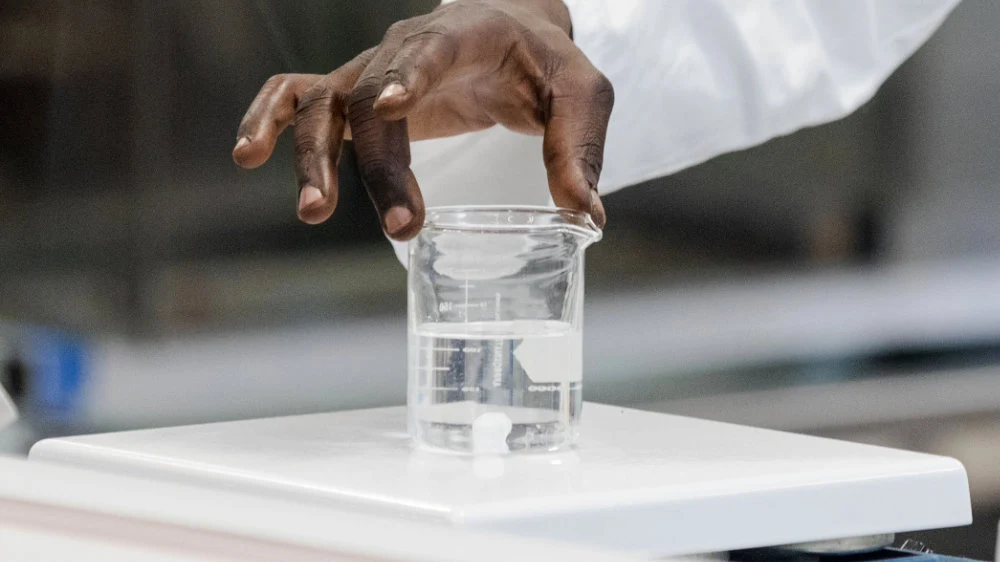
Sodium potassium tartrate, a key component of the working buffer used in SEAL's EPA-111 and EPA-136 methods, is especially susceptible to ammonia contamination.
To address this, SEAL's methods specify an alkaline boiling procedure when preparing the sodium potassium tartrate solution.* The solution must be boiled for one hour to drive off ammonia contamination, then cooled and adjusted to the appropriate pH before it can be incorporated into the final working buffer.
This is in addition to preparing the other reagents required for the method. Under the existing reagent preparation procedures, working salicylate/nitroferricyanide and sodium hypochlorite solutions are prepared fresh every third day.
For busy laboratories, these steps represent a recurring investment of time and attention.
With Inorganic Ventures' Ready-to-Use TKN Reagents, laboratories can skip these preparation procedures entirely.
The reagents arrive professionally prepared, with no routine mixing or dilution required. Eliminating the in-house preparation of sodium potassium tartrate also removes the need for its lengthy alkaline boiling procedure, while reducing opportunities for ammonia contamination during reagent preparation.
Proper laboratory handling and contamination control remain important after opening, but removing these demanding preparation steps can make the TKN workflow considerably simpler.
Ready-to-Use Reagents Developed for SEAL TKN Methods
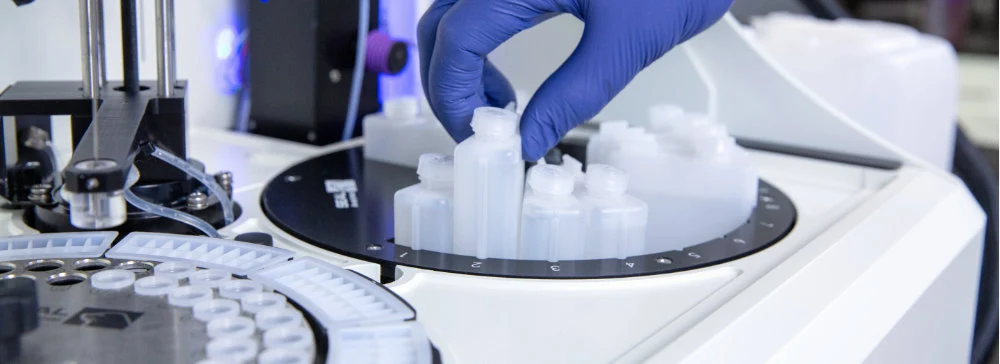
The new reagents are formulated as direct replacements for the colorimetric reagents specified in SEAL Analytical methods EPA-111 and EPA-136, which use a copper sulfate catalyst during Kjeldahl digestion.**
They are intended for use with SEAL AQ300, AQ400, and AQ700 discrete analyzers.
Both methods utilize a salicylate-based colorimetric reaction to determine ammonia after digestion (Berthelot reaction), with absorbance measured at 660 nm. Their primary differences include the analytical range, sample and reagent volumes, and working buffer formulation.
Comparing SEAL Methods EPA-111 and EPA-136
| Method Specifications | EPA-111 | EPA-136 |
|---|---|---|
| Range of Application | 0.2–4.0 mg N/L | 0.5–25.0 mg N/L |
| Method Detection Limit (MDL) | 0.07 mg N/L | 0.1 mg N/L |
| Detection Chemistry | Salicylate colorimetry (Berthelot reaction) | Salicylate colorimetry |
| Detection Wavelength | 660 nm | 660 nm |
| Sample Volume for Colorimetric Analysis | 100 µL | 32 µL |
| Reagent Volume for Colorimetric Analysis | 345 µL | 385 µL |
| Method Equivalence | EPA 351.2, Rev 2 (1993) SM 4500-Norg D | EPA 351.2, Rev 2 (1993) SM 4500-Norg D |
Specifications are based on existing SEAL AQ400 methods EPA-111-C Rev. 1A and EPA-136-C Rev. 2. Comparable methods are available for AQ300 and AQ700 discrete analyzers.
Both methods are used to determine TKN in drinking water, groundwater, surface and saline waters, and domestic and industrial wastewater. They employ copper-catalyzed Kjeldahl digestion followed by automated colorimetric analysis.
Which Ready-to-Use Reagents Do I Need?
Although the two SEAL methods use the same colorimetric chemistry, they require slightly different working buffer formulations.
Inorganic Ventures is introducing four products to support both methods. The Working Salicylate/Nitroferri-CN and TKN Hypochlorite reagents are compatible with both methods, while the Working Buffer is specific to each method.
| SEAL Method | Existing SEAL Reagent | Inorganic Ventures Ready-to-Use Reagent |
|---|---|---|
| EPA-111 | | SEALANALYTICALAQTKN111 BUFFER |
| EPA-111 | TKN Working Salicylate/Nitroferri-CN | SEALANALYTICALAQTKN111COLOR136 |
| EPA-111 | TKN Hypochlorite | SEALANALYTICALAQTKN111NaOCl136 |
| EPA-136 | | SEALANALYTICALAQTKN136 BUFFER |
| EPA-136 | TKN Working Salicylate/Nitroferri-CN | SEALANALYTICALAQTKN111COLOR136 |
| EPA-136 | TKN Hypochlorite | SEALANALYTICALAQTKN111NaOCl136 |
Simply select the appropriate buffer for your method, along with the two common colorimetric reagents.
Important Method Compatibility Information
These reagents are designed for the colorimetric determination of ammonia following Kjeldahl digestion. They do not replace the chemicals used during the digestion step itself.
The products are direct replacements for the colorimetric reagents in SEAL methods EPA-111 and EPA-136 and are not directly compatible with other SEAL TKN methods.
Although no routine dilution or preparation is required, a small addition of sodium hydroxide to the working buffer may occasionally be necessary to maintain the appropriate reaction pH. This depends on the sample-to-digestion-reagent ratio used during the digestion process.
For questions about compatibility with other SEAL methods or instrumentation, contact our team at sales@seal-us.com.
Professionally Prepared, Protected, and Ready to Use
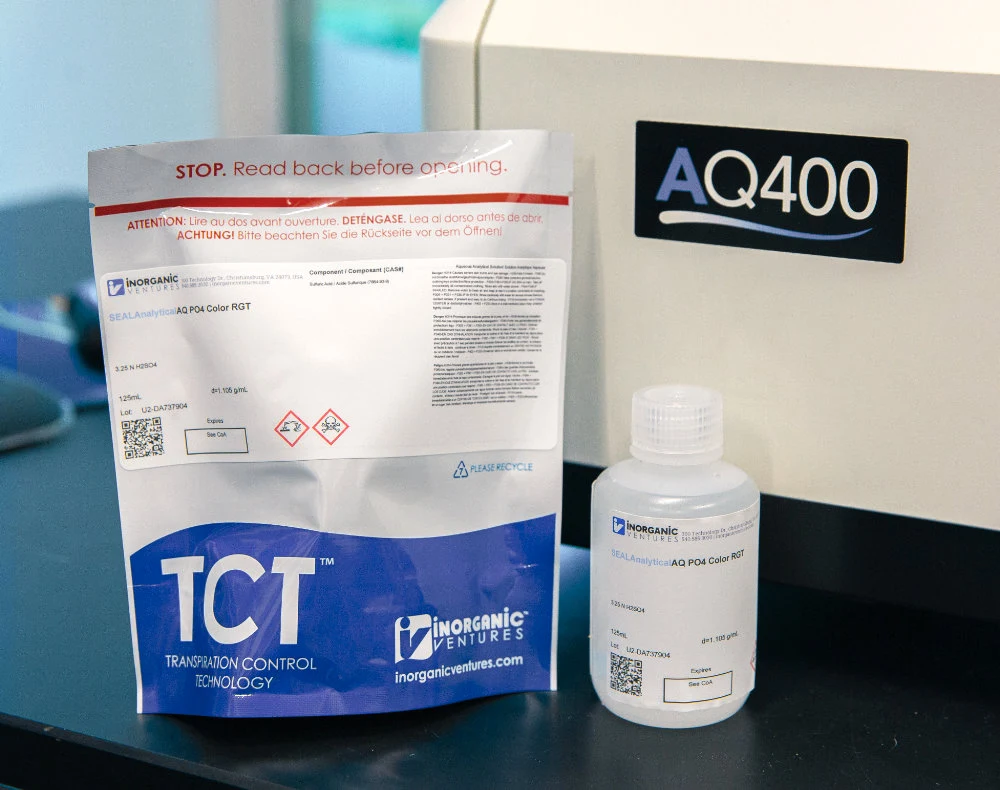
Inorganic Ventures' expertise in reagent manufacturing and packaging brings additional convenience to SEAL laboratories.
The new TKN reagents will be supplied in 125 mL bottles, each protected by Inorganic Ventures' proprietary Transpiration Control Technology (TCT) packaging.
TCT uses a multilayer barrier bag designed to limit moisture loss and exposure to light and oxygen before opening. By limiting these sources of environmental exposure, the packaging helps protect the integrity of solutions during storage.
The new TKN reagents will have an initial 12-month shelf life, with stability testing ongoing for potential extended shelf life.
For proper storage and use, refrigerate the reagents, protect them from light, and allow them to reach room temperature before use if necessary.
Learn more about Inorganic Ventures' Transpiration Control Technology.
Expanding Our Ready-to-Use Reagent Range
SEAL Analytical and Inorganic Ventures share a common goal: helping laboratories spend less manual time on routine preparation and testing, and more time producing meaningful analytical results.
Our existing Ready-to-Use Reagent range supports methods for ammonia, nitrate, nitrite, phosphate, sulfate, chloride, and other common analytes.
The addition of TKN reagents is an especially exciting step forward because it addresses a challenge that goes beyond the convenience of reagent preparation. Removing the need for lengthy alkaline boiling and reducing opportunities for ammonia contamination provide practical benefits for laboratories performing this important analysis.
Available December 15, 2026
The new Ready-to-Use TKN Reagents will officially launch on December 15, 2026, when the first production lots become available for ordering and shipment directly from Inorganic Ventures.
Explore Ready-to-Use Reagents from Inorganic Ventures
Before then, we invite you to join our upcoming webinar to explore ammonia and TKN chemistry, discover the new reagents, and learn how they can fit into your laboratory workflow.
Register for Optimizing Ammonia & TKN Analysis: Digestion, Reagents & Troubleshooting
Unable to attend? All registrants will receive a recording of the webinar immeidately following the event. Contact inform@seal-us.com for questions or more information.
We're looking forward to bringing this highly requested addition to the Ready-to-Use Reagent family to your laboratory!
*Contact our Technical Support team to inquire about TKN methods that use alternate buffers with reagents that do not require an alkaline boil.
**If interested in SEAL methods for TKN analysis after a Kjeldahl digestion using mercury sulfate in place of copper sulfate, contact our Technical Support team.


