
What is a Discrete Analyzer?
.jpg?resolution=2210x1244&quality=95&type=webp)
Introduction
A discrete analyzer is an automated laboratory instrument used to perform chemical analyses on individual samples in separate (discrete) reaction vessels. Unlike continuous flow analyzers, each sample is processed independently, allowing for flexible testing, less fluidic complexity, and easier day-to-day operation.
Discrete analyzers are widely used in many industries, including environmental monitoring, water analysis, agricultural sciences, clinical laboratories, food and beverage industries, and more.
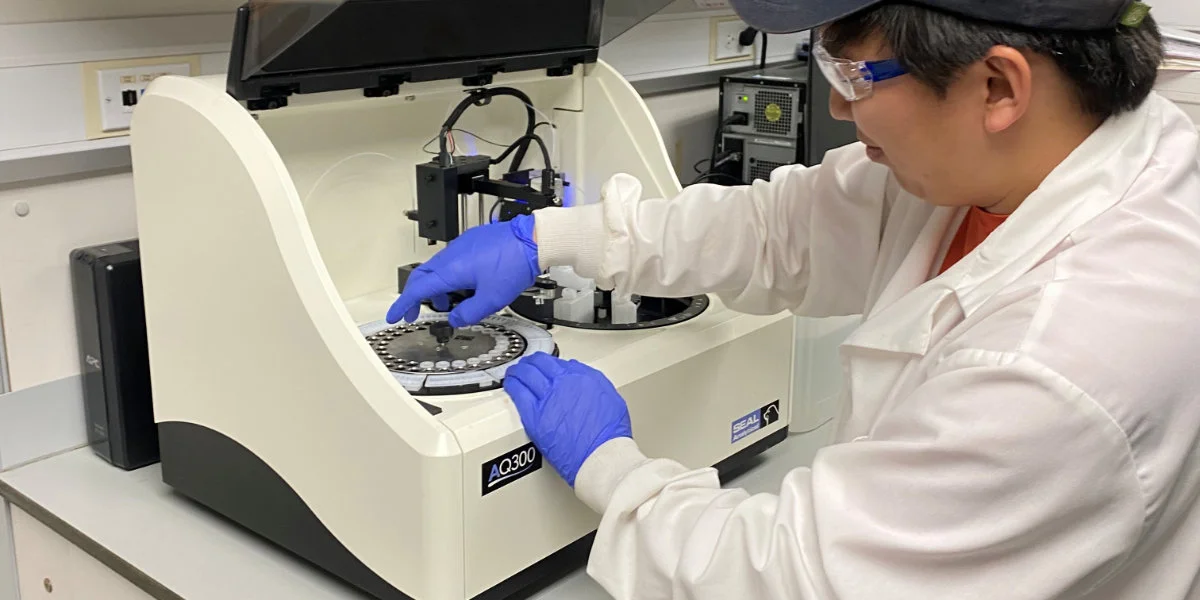
What Does a Discrete Analyzer Do?
At its core, a discrete analyzer automates manual wet chemistry methods, typically colorimetric methods. These methods utilize a reagent or reaction pathway that produces a colored compound when in the presence of the analyte. A colorimeter is then used to measure the absorbance of the solution at a specific wavelength. In general, a higher color intensity corresponds to higher absorbance and a higher analyte concentration.
Instead of preparing samples, adding reagents, timing reactions, and measuring absorbance by hand, the analyzer performs each step automatically. This includes:
- Performing sample dilutions, spikes, and calibration standards
- Pipetting precise volumes of sample and reagents
- Mixing and incubating reactions
- Measuring absorbance using photometric detection
- Calculating results based on calibration curves
Each test is performed in an individual cuvette or reaction well, meaning multiple parameters can be analyzed on the same samples in a single run.
How Does a Discrete Analyzer Work?
Discrete analyzers follow a simple but highly controlled workflow. This process is performed with tightly controlled timing, temperature, and reagent handling, allowing discrete analyzers to produce results significantly faster and more consistently than manual methods.
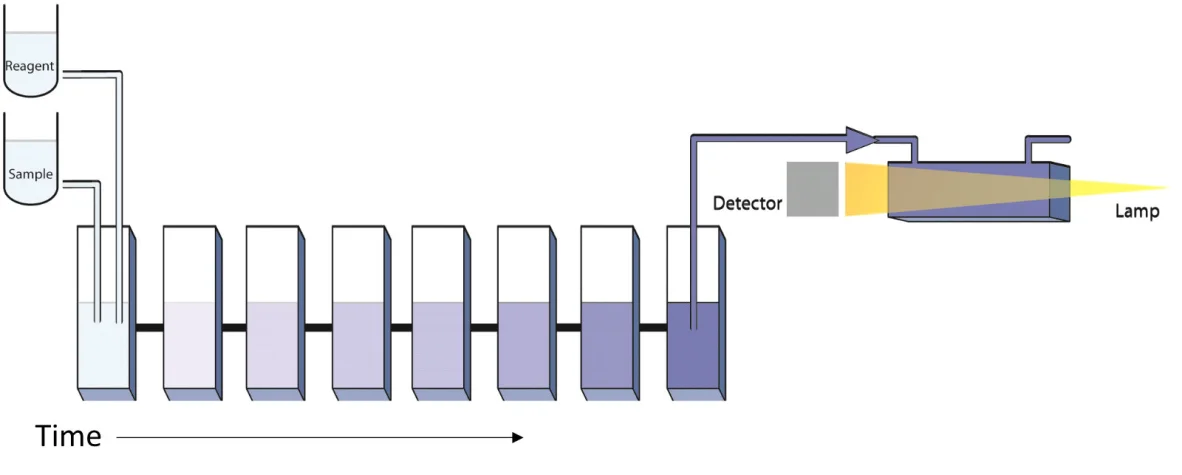
1. Sample and Reagent Addition
The system aspirates a defined volume of sample and reagents and dispenses them into a reaction well.
2. Mixing and Reaction
The solution in the reaction well is mixed, and the chemical reaction develops under controlled timing and temperature conditions.
3. Detection
The analyzer measures the intensity of color formed using a photometer. The amount of light absorbed (absorbance) corresponds to the concentration of the analyte.
4. Calculation
Results are calculated automatically using a calibration curve generated from known standards.
What Are Discrete Analyzers Used For?
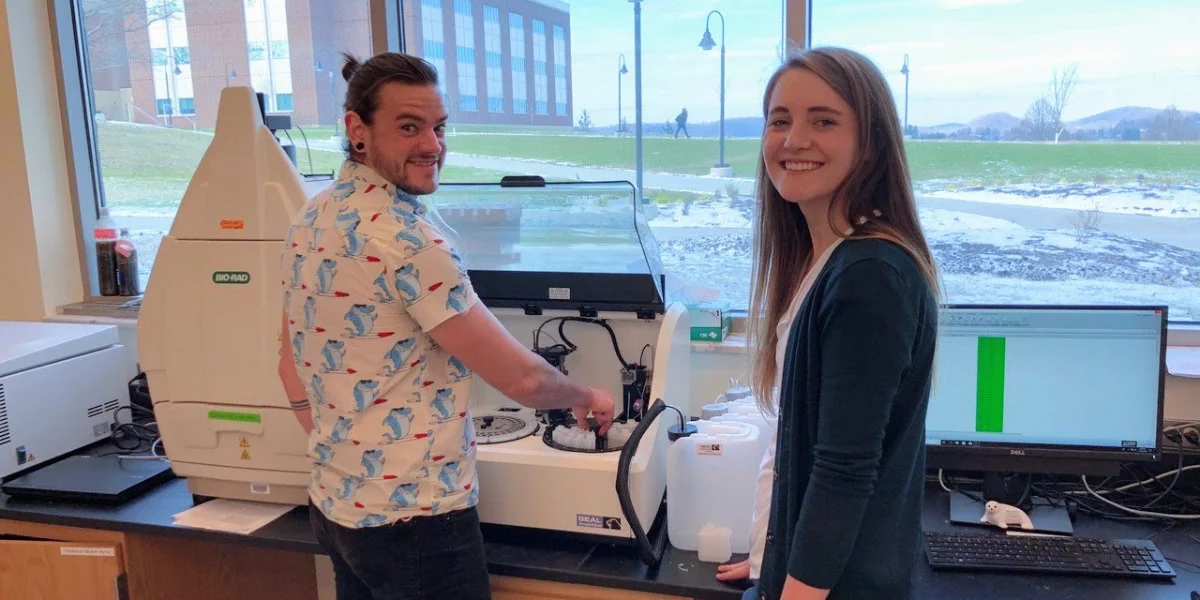
Discrete analyzers were originally developed for clinical laboratories, where automated, high-throughput testing was essential to keep up with demand at hospitals for bloodwork and other assays. Over time, the technology expanded into industrial and environmental applications, where similar needs for accuracy, consistency, and efficiency exist.
Today, discrete analyzers are used across a wide range of multiple industries. SEAL discrete analyzers, in particular, are designed specifically for environmental testing and are commonly used for nutrient analysis in water, wastewater, soil, and related sample types.
Nutrient Analysis
Discrete analyzers excel at automating colorimetric methods for nutrient analysis, including:
- Ammonia
- Nitrate and nitrite
- Phosphate and Total Phosphorus
- Total Kjeldahl Nitrogen (TKN)
- Cyanide
- Chloride
- Sulfate
- Phenolics
Environmental, Soil, and Agricultural Testing
These methods are widely applied in laboratories performing:
- Drinking water compliance testing
- Wastewater monitoring
- Surface water analysis
- Seawater research
As well as agricultural applications such as:
- Extractable nutrients in soil
- Plant tissue analysis
- Fertilizer quality control
Industrial and Other Applications
Beyond water and agricultural laboratories, discrete analyzers are also used in a variety of industrial settings where automated wet chemistry improves consistency and throughput.
For example:
- Chemical production facilities monitoring water discharge to maintain environmental compliance
- Food and dairy laboratories testing parameters such as nitrate and nitrite to ensure product quality
- Contract and private laboratories bringing previously outsourced analyses in-house
This flexibility is one of the key reasons discrete analyzers have become a standard tool across many types of laboratories.
🔎 Click here to see the latest research publications utilizing SEAL discrete analyzers.
Why Do Laboratories Use Discrete Analyzers?
1. True Automation
Discrete analyzers eliminate manual steps, allowing laboratories to load samples, walk away, and even leave the lab for the day while the system performs the analysis.
2. Flexibility
Multiple parameters can be run on a single sample without reconfiguring hardware. The analyzer uses programmable arms rather than dedicated glass tubing or components to perform the analysis, so there is no need to purchase additional modules when adding a new parameter to the workflow.
3. Low Reagent Consumption
Typical methods use less than 1 mL of total reagents per test on SEAL discrete analyzers, reducing operating costs and waste.
4. Minimal Carryover
SEAL discrete analyzers use cleaning systems intentionally designed for environmental methods, helping them achieve extremely low detection limits and eliminating carryover between samples. The sample arm uses a traveling probe washer that keeps the probe clean and droplet-free before each movement on the analyzer.
5. High Data Quality
Automated timing, mixing, and detection improve reproducibility and consistency compared to manual methods, keeping procedures and results uniform between samples, batches, and analysts.
Discrete Analyzer vs. Segmented Flow Analysis
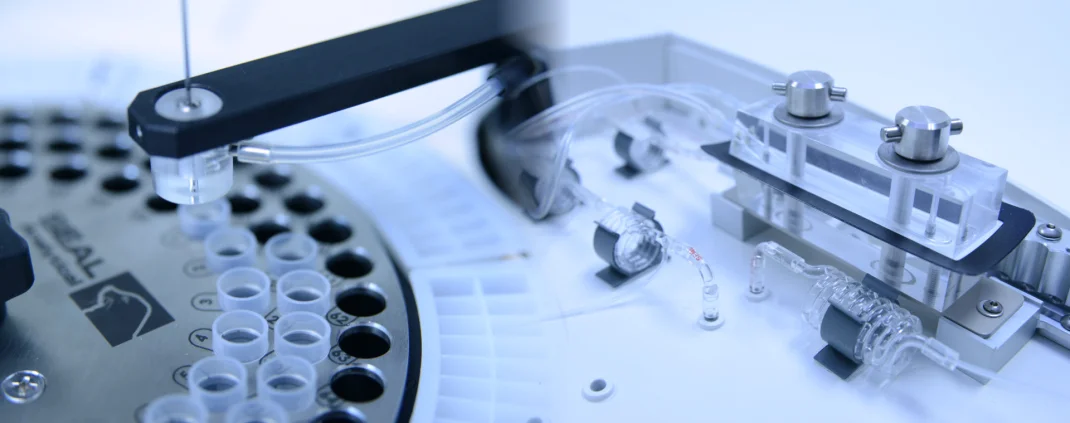
Both discrete analyzers and segmented flow analyzers automate wet chemistry and nutrient testing efficiently, providing reproducible results, low detection limits, and high throughputs. However, they do so in fundamentally different ways that offer different strengths.
| Feature | Discrete Analyzer | Segmented Flow Analyzer |
|---|---|---|
| Reaction Handling | Individual reaction wells | Continuous flow stream separated by gas bubbles |
| Automation Style | Robotic arms with aspiration and dispense capabilities | Glass tubing manifolds with reagent injection points, mixing coils, heating baths, and other apparatuses |
| Sample and Reagent Measurement | High-precision syringe | Flow-rated peristaltic pump tubes |
| Ease of Use | Simple user interface, easy day-to-day operation, easy maintenance | Requires more instrument knowledge, fluidic monitoring, easy maintenance |
| Detection Limits | Low, meets or exceeds needs of most labs | Ultra-low for highest demands in trace-level testing |
| Method Flexibility | High - each system comes ready to run the full method list | Moderate - some manifolds can run multiple methods, others are dedicated to a specific method |
| Throughput | Moderate to High - one detector per system | Extremely high - multiple detectors per system |
| Best For | Multi-parameter labs with moderate-to-high throughputs | High-volume labs with a dedicated list of parameters; inline sample pretreatment (distillation, digestion, etc.) |
How Are SEAL Discrete Analyzers Different?
SEAL Analytical discrete analyzers are designed by chemists for chemists, with a focus on high performance on environmental methods and long-term reliability.
Key differentiators include:
- Lower detection limits and higher reproducibility, using a single quartz cuvette for the highest optical purity in detection rather than individual styrene cuvettes for sample measurement
- Eliminated cross-contamination with strategic wash stations ensuring probes are clean and dry before movement
- Inexpensive consumables - reaction wells do not need to be made optically pure as analysis takes place in an optically-pure quartz cuvette
- Robust handling of challenging matrices like wastewater
- Long-term support, including systems that remain in operation for decades
Whether a laboratory is running a few samples per day or managing high-throughput workflows, SEAL systems are built to deliver consistent, high-quality results.
Conclusion
Discrete analyzers have become a cornerstone of modern environmental laboratories by automating traditional wet chemistry methods while improving accuracy, efficiency, and consistency.
Their flexibility, low reagent usage, ability to handle multiple parameters on a single sample, and unattended operation make them an ideal solution for laboratories looking to streamline operations without compromising data quality.
Interested in how discrete analyzers fit into your laboratory workflow?
Explore SEAL Analytical’s discrete analyzer range or connect with our team to discuss your application.
Related articles
.jpg?resolution=856x534&quality=95&type=webp)
.jpg?resolution=856x534&quality=95&type=webp)
